Awarding School Nutrition Commercial Bids
March 15, 2026
Community Eligibility Provision (CEP) Financial Analysis and Sustainability: What Program Leaders Need to Know
May 9, 2026
School nutrition training is often measured in hours. Directors track USDA Professional Standards requirements. Staff complete modules. Certificates are filed. The box is checked until the next training cycle.
But education that only fulfills required training hours rarely changes a program. It doesn’t improve consistency. Sometimes it strengthens accountability. It may reduce costs (but will you know?). And it often doesn’t help staff understand why their work matters.
Strong school nutrition training programs should do more. Along with building operational clarity and supporting leadership, it should impact the meal program’s financial health. The curriculum should help staff perform their tasks with confidence and give directors tools to manage programs more effectively.
Effective training is grounded in these five things:
- Training should be built around USDA regulations and district procedures
- Training should be connected to written standard operating procedures (SOPs)
- Training should improve operational consistency
- Training should support staff accountability and performance
- Training should strengthen the financial health of the program
When these five elements are present, training moves beyond compliance and becomes a driver of program performance.
1. Training Should Be Built Around USDA Regulations and District Procedures
School meal programs operate within a structured regulatory environment. USDA meal pattern requirements, food safety rules, procurement guidelines, and local district procedures all shape daily operations. Training should reflect that reality.
When school nutrition training is disconnected from regulations, staff may learn general concepts but struggle to apply them in real-world kitchens, leading to confusion and inconsistency. Staff make decisions based on habit instead of standards.
Why Ground Training in USDA Regulations?

Training that is grounded in USDA regulations helps staff understand:
- Why the meal pattern matters
- How portion sizes impact compliance
- What qualifies as a reimbursable meal
- How production records support accountability
- Why food safety procedures must be followed consistently
This type of training builds clarity. Staff are no longer following just instructions. They understand the purpose behind the work.
For example, SproutCNP’s course “School Nutrition is Rooted in Nutrition Science” helps staff connect nutrition basics to program requirements and healthy menu planning. When staff understand how components contribute to reimbursable meals, they are more likely to portion correctly, reduce mistakes, and maintain compliance.
Training built around nutrition science also strengthens decision-making. Staff learn:
- Why whole grains are required
- Why sodium limits matter
- How fruit and vegetable subgroups impact menus
- How menu substitutions affect compliance
This knowledge changes behavior. Instead of relying on memory or guessing, staff make informed choices aligned with program standards.
School Nutrition Training & District-Specific Procedures
Training should also incorporate district-specific procedures. Every program has operational expectations:
- Production record completion
- Menu substitution policies
- Temperature logging procedures
- Cleaning and sanitizing standards
- Inventory management processes
When training reflects these procedures, staff gain consistency across kitchens. Directors spend less time correcting issues and more time leading operations.
Training grounded in USDA regulations and district procedures creates a shared understanding. Everyone is working from the same expectations.
2. Training Should Be Connected to Written SOPs
Training is most effective when it reinforces documented procedures. Without written Standard Operating Procedures (SOPs), training becomes difficult to sustain. Staff may complete training and pass competency checks but return to inconsistent practices.
When training and SOPs work together, expectations become clear and repeatable.
Why Connect School Nutrition Training To SOPs?
SOP-connected training allows directors to:
- Standardize processes across kitchens
- Reinforce expectations consistently
- Train new staff efficiently
- Support managers with clear guidance
- Reduce operational confusion

For example, knife skills training improves efficiency. But when connected to SOPs, it becomes operational practice. In SproutCNP’s “Knife Skills for School Nutrition Professionals” course, staff learn:
- How to hold knives safely
- How to cut consistent portions
- How to work efficiently during prep
- How to reduce waste
- How to maintain safety standards
These skills can then be written into prep procedures. New staff learn the same techniques. Managers reinforce the same expectations. The result is consistent, quality food production.
Another example is production planning and kitchen workflow. Training on time standards and work schedules helps staff understand how work should be timed and organized. When tied to SOPs, it becomes part of daily operations.
We’ve seen this type of training remove uncertainty after districts have taken our course, “Put Me in Coach: Time Standards and Work Schedules.” Staff learn:
- Who is responsible for each task
- When prep should begin
- How long tasks should take
- How work flows through the kitchen
- What managers expect each day
This structure improves efficiency and reduces chaos. Kitchens run more smoothly because expectations are documented and reinforced through training.
SOP-connected training also supports onboarding. New staff don’t rely solely on verbal instruction. They learn procedures through structured training and written expectations, which reduce variation and improve long-term consistency.
3. Training Should Improve Operational Consistency
Consistency is one of the biggest challenges in school meal programs. Think about these scenarios and how they often create visible differences in operating. Multiple kitchens. Different staffing levels. Varying experience. Changing schedules.
Training should reduce that variability.
How Does Training Improve Operational Consistency?
When training improves consistency, programs see:
- More uniform meal quality
- Better portion control
- Fewer production errors
- Improved food safety practices
- More predictable labor use

Operational consistency also supports student experience. When meals are prepared consistently, students know what to expect. Quality improves, and participation can increase.
Culinary skill training plays an important role in consistency. Knife skills, prep methods, and standardized recipes help staff produce food the same way across kitchens.
For example, standardized cutting techniques lead to:
- Even cooking
- Better appearance
- Accurate portioning
- Reduced waste
- Faster preparation
These improvements may seem small individually, but collectively they strengthen operations.
Consistency also comes from workflow training. When staff understand time standards and work schedules, kitchens operate more predictably. Tasks are completed in the correct order. Staff work together efficiently, which reduces:
- Last-minute scrambling
- Over or under production
- Service delays
- Staff frustration
Consistency supports managers as well. When expectations are clear, managers spend less time troubleshooting and more time leading.
Training that improves operational consistency strengthens the entire program.
4. Training Should Support Staff Accountability and Performance
Training should define expectations. Without clear expectations, accountability becomes difficult. Staff may not know what performance looks like or how their role contributes to program success.
How Does School Nutrition Training Affect Performance?
School nutrition training that supports accountability provides structure. Employees understand:
- What is expected
- How tasks should be completed
- How performance is measured
- How their work impacts the program
- How managers evaluate success
This clarity improves performance.
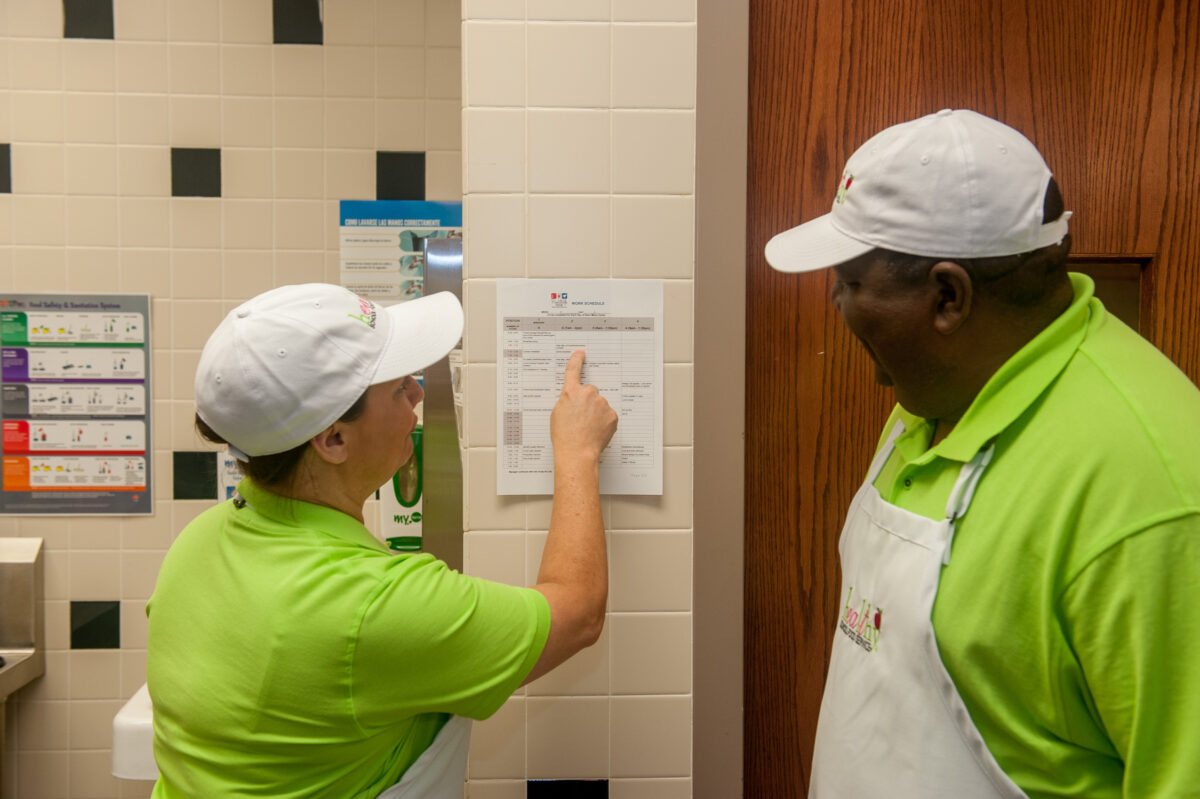
Training focused on time standards and work schedules is one example. When staff understand the expected workflow, performance becomes measurable. Managers can identify:
- Tasks taking too long
- Staffing imbalances
- Inefficient processes
- Missed responsibilities
- Training gaps
This evaluation shifts conversations from opinion to structure. Managers can coach staff using defined expectations.
Accountability-based training also supports leadership development. Kitchen managers gain tools to guide staff effectively. Instead of reacting to issues, they manage proactively.
Training helps managers:
- Assign tasks clearly
- Monitor progress
- Reinforce expectations
- Address performance issues
- Recognize strong performance
Managers who lead in this way improve team culture because staff understand their roles and responsibilities.
Accountability also improves program outcomes. When staff follow procedures consistently, operations stabilize. Food quality improves. Waste decreases. Service becomes smoother.
Training that supports accountability strengthens both staff performance and leadership effectiveness.
5. Training Should Strengthen the Financial Health of the Program
Training should directly impact financial outcomes. School meal programs operate within tight budgets. Labor costs, food costs, and participation all influence financial stability.
Training can improve each of these areas.
When staff understand the cost impact, they make different decisions. Training that focuses on yield, waste reduction, and efficient prep builds financial awareness.
For example, SproutCNP’s training on As Purchased (AP) versus Edible Portion (EP) helps staff understand:
- Yield differences in produce
- How trimming impacts cost
- Why portion control matters
- How waste affects budgets
- How prep decisions influence ordering
This type of training gives staff ownership in the program’s financial health. They see how their daily actions affect the program.

When staff apply yield concepts, programs may see:
- Reduced food waste
- More accurate ordering
- Improved portion consistency
- Better menu cost control
- Increased financial stability
Culinary skill training also affects finances. Improved knife skills reduce prep time and labor hours. Consistent cuts reduce waste. Efficient workflows improve productivity.
These operational improvements translate to financial gains for the school meal program.
School nutrition training that focuses on scheduling and time standards also supports financial health. When labor is aligned with workload:
- Overtime decreases
- Idle time is reduced
- Staffing becomes predictable
- Managers schedule more effectively
- Labor costs stabilize
Financially strong programs are built on operational discipline. Training provides that foundation.
Moving Beyond School Nutrition Training Hours
When training includes these five things, it becomes a strategic tool:
- Built around USDA regulations and district procedures
- Connected to written SOPs
- Designed to improve operational consistency
- Structured to support accountability and performance
- Focused on strengthening financial health
This type of training supports the entire program. Everyone wins as staff gain clarity, managers receive structure, and directors experience program stability.
School nutrition training should do more than educate. It should positively change operations. When training is built with purpose, the results extend beyond the classroom and into every kitchen.
Study Questions
Training built around USDA rules and district procedures helps staff understand meal pattern requirements, food safety expectations, and daily operational standards. This structure reduces errors, improves compliance, and creates consistency across kitchens.
Written SOPs reinforce training by documenting expectations and standardizing procedures. When training aligns with SOPs, staff follow consistent methods, new employees are easier to onboard, and managers can support accountability.
Training improves operational consistency by standardizing food preparation, portioning, and workflow. This leads to more uniform meals, fewer production errors, improved food safety, and smoother service.
Training supports accountability by defining roles, expectations, and time standards. Managers can use this structure to monitor performance, coach staff, and ensure tasks are completed consistently.
Training strengthens financial health by reducing waste, improving labor efficiency, and supporting accurate portioning. Staff learn how daily decisions impact food costs, labor hours, and overall program sustainability.